Abigail Carlo ’25 was recently published in the Massachusetts National Classical Newspaper. Read her article here!
Rome wasn’t built in one day, neither were the innovative inventions of the Roman Empire: from roads to the first apartments, the Romans created many structures necessary to our lives today. Although it may seem counterintuitive, they are also responsible for laying the foundation of modern engineering ideas still being utilized in our society. Using their extensive knowledge about math and architecture, Roman engineers designed impressive buildings that were revolutionary for their time, and they did this all without the help of modern technology that engineers have access to now.
The Roman Empire was known for its elaborate system of aqueducts, spanning hundreds of kilometers to supply fresh water to urban areas. By using gravity and directing the water downhill, aqueducts could supply water from up to 52 miles away! Today, some of these aqueducts still transport water to Rome. Thousands of years later, this magnificent invention made its way over to Massachusetts. The Wachusett Aqueduct is used to help supply the greater Boston area with clean drinking water, showcasing the lasting impact of Roman engineering on the modern world.
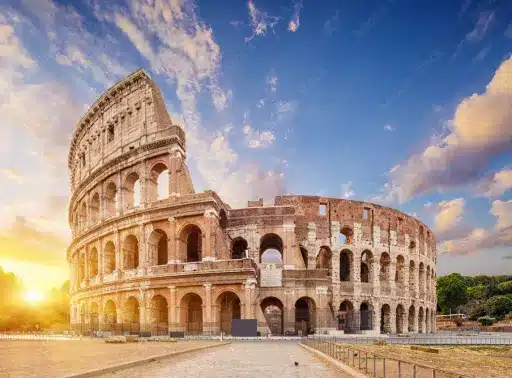
Another example of Roman engineering is the amphitheater. In ancient times, the Colosseum was a massive amphitheater (having a maximum capacity of 50,000 spectators) that hosted gladiatorial games, dramas, and even executions. The engineering behind this great feat allows sound to travel far and remain clear. Additionally, elevated seats enable sound waves to travel to each level so the sound is audible to the entire audience. Amphitheaters are still frequently used today. Whether it’s Gillette Stadium or many school auditoriums, this technology still effectively circulates sound throughout the amphitheater.
Lastly, even though the Romans did not invent the arch, they advanced the technology to build large bridges and aqueducts, as well as other creations. By compressing pressure downwards and outwards, the arch can support great amounts of weight, thus enabling the Romans to build giant structures. Today, the arch is commonly used in modern architecture across the US, Europe, and many other parts of the world. In Massachusetts, the well-known Cape Cod Bridges (Bourne and Sagamore), spanning 616 feet, are examples of modern-day arches. With 50,000 daily commuters, these arch-style bridges continue to exhibit the lasting impact that Roman engineering has had on the modern world.
Even though the Roman Empire is thousands of years old, its innovation and architectural advancements have played a key role in shaping modern engineering. Many of their creations and developments still have important and functional roles in our modern day and age. Their precision and detail allowed them to design these masterworks of engineering, employing concepts of physics and advanced mathematics to ensure the success of these creations. Next time you’re at a concert at a stadium or driving over a large bridge, thank the Romans for helping modern engineers design these great feats!