Mathematics

Mathematics Courses

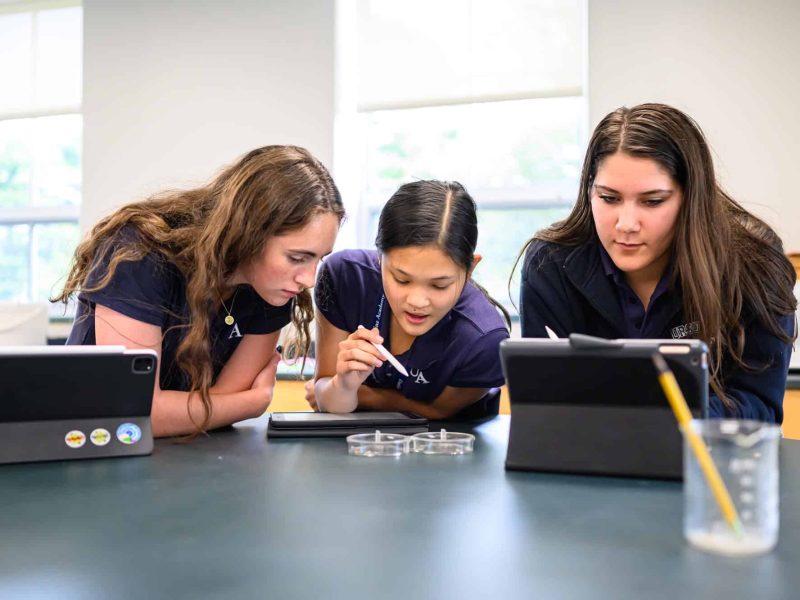
Perhaps more than any other subject, mathematics is cumulative; students layer new concepts onto previous learning. The pace of moving forward within the curriculum, therefore, is guided primarily by students’ genuine mastery of foundational material. Teachers design learning experiences that encourage curiosity and engender intrigue, providing students with many opportunities to synthesize their learning. At Ursuline, students develop a robust problem-solving ability, with emphasis on demonstrating advancing critical thinking capacities as they work toward solutions. Courses are designed to appropriately challenge students, meeting them where they are and encouraging them to take risks. The satisfaction that comes from successful engagement with the material in real-world applications is palpable, and highlights students’ developing abilities to draw on mathematical thinking practices and knowledge in a broader context. 

Pre-Algebra AB

Intended for students with a strong preparatory background in arithmetic and problem solving, this one-year Pre-Algebra course includes all standard topics of middle school mathematics and introduces students to operations with rational and irrational numbers. Students gain proficiency in: evaluating expressions; writing and solving equations and inequalities outright as well as in real-world contexts; linear equations and graphs; and probability. Teachers focus attention on developing excellent mathematical habits such as reading mathematics, writing about solutions, and producing work that is neat and complete.

Students enrolled in Algebra 1 acquire facility in applying algebraic concepts and skills to operations with polynomials, fractions, and exponents, and learn to solve more complex equations and inequalities. Teachers introduce graphing solution sets of open sentences in two variables, including linear equations and inequalities. These techniques are then expanded to exponential, quadratic, and rational equations and functions as the course progresses. Through this and other math courses, students rely on and further develop problem solving techniques and fortify critical thinking abilities.

In this course, students master the basic structure of Euclidean, or plane and solid, Geometry. Students develop deductive reasoning powers as they are led to visualize relationships among geometric elements. Geometry and algebra serve as complementary fields of mathematics. Coursework in geometry will reinforce and expand the skills learned in previous algebra courses. Additionally, the course aims to help students acquire precision in their use of mathematical language and further develop their critical problem-solving skills in increasingly creative ways.

Students in Honors Geometry reason using postulates and theorems in paragraph, indirect, and formal proofs. Students interact in groups discussing, writing, and communicating ideas towards solutions to real-world problems. They look for patterns and write mathematical models. Throughout the course, the teacher presents Euclidean geometry with an emphasis on algebraic concepts. The course contributes to the development of the student’s habits of detailed, precise mathematical language and logic.

In Algebra II, students explore functions and their characteristics both graphically and algebraically. This includes a deeper consideration of domain and range, operations with functions, and inverse functions. Types of functions studied include linear, quadratic and higher order polynomial, radical, rational, exponential, and logarithmic functions.

Honors Algebra II is primarily a fast-paced study of functions. In particular, emphasis is placed on: defining functions, inverse functions, and the relationship between the two; operations with functions; and domains and ranges of functions. Students learn about linear, quadratic and higher order polynomial, radical, rational, exponential, logarithmic, and trigonometric functions.

In this class, many of the concepts previously studied in Algebra II are covered, formulating those concepts in two manners – algebraically and graphically. Solidly grounded in the idea of functions and their characteristics, students expand learning in previously explored areas of mathematics such as logarithms and exponents, among others. As well, students engage in an in-depth study of trigonometric ratios and functions, exploring them graphically, algebraically and numerically. Students rely on their problem-solving skills to engage real-world situations with the utilization of technology such as the graphing calculator.

In Honors Precalculus, we cover many of the concepts previously studied in Algebra II, formulating those concepts in two manners – algebraically and graphically. Solidly grounded in the idea of functions and their characteristics, students expand their learning in previously explored areas of mathematics such as logarithms and exponents, among others. As well, students engage in an in-depth study of trigonometric ratios and functions, exploring them graphically, algebraically, and numerically. Students conclude the year with an introduction to limits. Students rely on their problem-solving skills to engage real-world situations with the utilization of technology such as the graphing calculator.

Students begin this course studying limits and continuity and progress to the definition and rules of derivatives, as well as applications of the derivative in real-world contexts including optimization, curve sketching, and related rates. Students use the graphing calculator to explore concepts and to verify and facilitate solutions. Students regularly communicate mathematics in words, verbally or in written format, to explain problem solutions.

In this class, students follow the curriculum as set by the College Board and may earn college credit through the Advanced Placement (AP) exam taken in the spring. AP Calculus AB is equal to one semester of college calculus. Students in this course explore the concepts, methods, and applications of differential and integral calculus. Coursework helps students understand the theoretical basis of calculus and solve problems by applying their previous knowledge and skills. Students gain skills such as determining expressions and values, justifying reasoning and solutions with evidence, and using correct notation, language, and mathematical conventions to communicate results or solutions.

In this class, students follow the curriculum as set by the College Board and may earn college credit through the Advanced Placement (AP) exam taken in the spring. AP Calculus AB is equal to two semesters of college calculus. Students in this course explore the concepts, methods, and applications of differential and integral calculus, including topics such as parametric, polar, and vector functions, and series. Coursework helps students experiment, investigate, and solve problems by applying their knowledge and skills. Students gain skills such as determining expressions and values, justifying reasoning and solutions with evidence, and using correct notation, language, and mathematical conventions to communicate results or solutions.

This course is offered to seniors. It may be taken concurrently with Calculus or Precalculus. This course introduces students to the field of Statistics. Concepts explored include: methods for collecting and describing data; graphical interpretation of data; frequency distribution and graphs; measures of central tendency, variation, and position; counting techniques; probability; normal distribution; confidence intervals; and hypothesis testing. Throughout the course, emphasis is placed on application of formulas as well as interpretation of results in real-life contexts.

In this course, students follow the curriculum as set by the College Board and may earn college credit through the Advanced Placement (AP) exam taken in the spring. Students learn the concepts and tools of computer science as they learn a subset of the Java programming language. Coursework includes hands-on work to design, write, and test computer programs that solve problems or accomplish tasks. Students design a program, develop the algorithms it needs, and write code to implement them. Expectations include correcting errors, neatly documenting the development process, and explaining how program code works.

In this course, students follow the curriculum as set by the College Board and may earn college credit through the Advanced Placement (AP) exam taken in the spring. Students learn the principles that underlie the science of computers and develop the thinking skills that computer scientists use. Students will work independently and collaboratively to creatively address real-world issues using the tools and processes of computation. The class encourages students to make connections between computing concepts, analyze computational work, and work collaboratively to solve problems. Coursework includes designing a program to solve a problem or complete a task, applying abstractions in computation and modeling, and communicating ideas about technology and computation.

Meet The Team

Natalie

Ward

Title: English Faculty

Department: English

Katie

Sheehan

Title: English Department Chair

Department: English

Matt

Murphy

Title: English Faculty

Department: English

Michael

Mayer

Title: English Faculty

Department: English

John

Baker

Title: English Teacher

Department: English